Article: What Is a Sextant? How It Works?
What Is a Sextant? How It Works?
For centuries, sailors crossed oceans without GPS, smartphones or satellite navigation. Instead, they relied on the Sun, Moon, stars, accurate timekeeping and beautifully engineered navigational instruments.
One of the most recognisable of those instruments is the sextant.
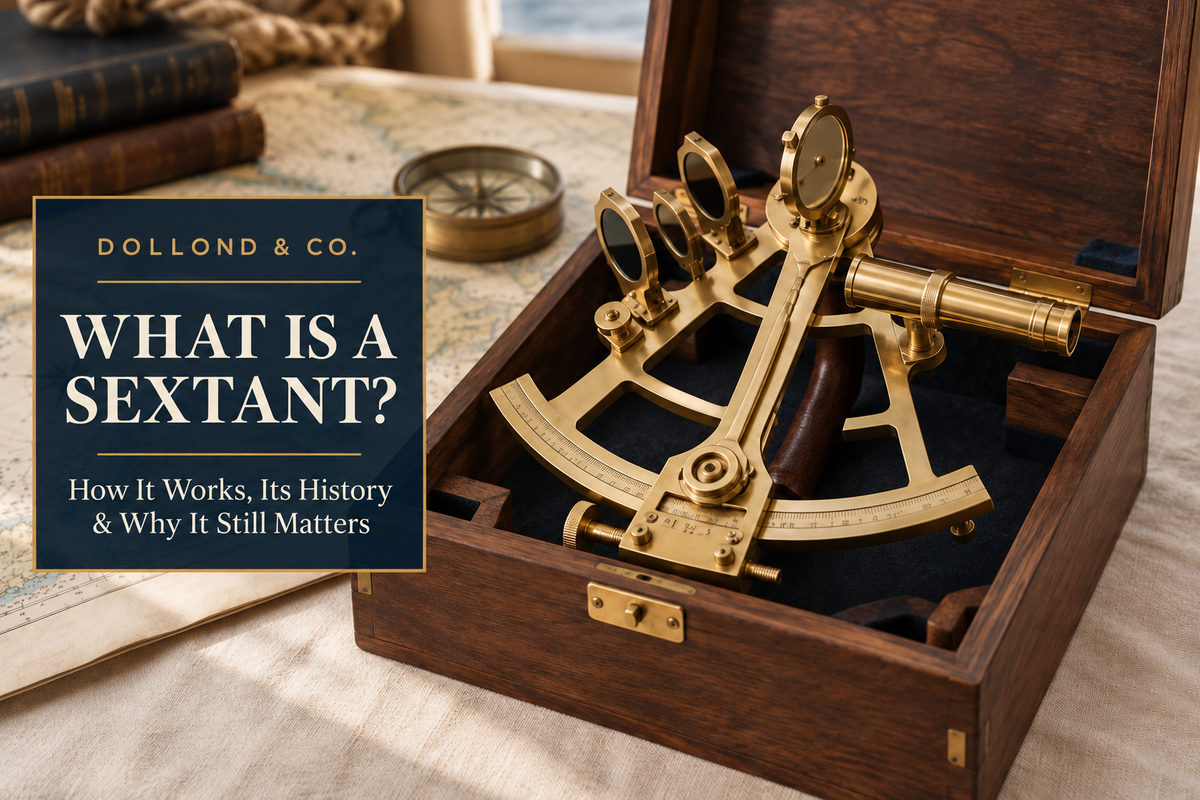
A sextant is an optical measuring instrument designed to measure the angle between two visible objects. At sea, this usually means measuring the angle between a celestial object—such as the Sun or a star and the horizon. Navigators can then combine that observation with the exact time and astronomical information to help determine their position. (PBS)
Although satellite navigation has transformed modern travel, the sextant remains one of the great symbols of maritime exploration, celestial navigation and traditional craftsmanship.
At Dollond & Co., we offer both personalised working-style sextants and collectible nautical instruments, making them particularly meaningful gifts for sailors, travellers, graduates, retirees and anyone fascinated by maritime history.
Explore the Dollond & Co. Sextant Collection
What Is a Sextant?
A sextant is a handheld optical instrument used to measure the angular distance between two visible objects.
In traditional celestial navigation, the navigator typically measures the altitude of the Sun, Moon, a planet or a star above the visible horizon. The sextant itself does not simply display a ship's latitude and longitude. Instead, it provides an extremely important measurement which can be combined with time, astronomical tables and navigation calculations to establish a position.
Unlike a magnetic compass, which primarily tells you direction, a sextant measures angles.
That distinction is important.
A compass can help answer:
Which direction am I travelling?
A sextant helps provide information for answering:
Where am I?
For navigators before electronic positioning systems, both were incredibly valuable.
How Does a Sextant Work?
The clever part of a traditional marine sextant is its use of two mirrors.
When looking through the telescope, the observer can see the horizon directly while also seeing a reflected image of a celestial object.
The movable index arm changes the angle of one of the mirrors. The navigator moves this arm until the reflected Sun or star appears to meet the horizon.
Once the two images are aligned, the angle can be read from the sextant's graduated scale.
This is known as the double-reflection principle.
It allowed sailors to take useful measurements even while standing on the deck of a moving vessel, which was a major advantage over several earlier astronomical instruments.
Why Is It Called a Sextant?

The name comes from the Latin idea of a sixth.
A traditional sextant's graduated arc covers approximately 60 degrees—one sixth of a full 360-degree circle. Because of the double-reflection optical system, a conventional marine sextant can measure angles considerably larger than the physical arc itself, typically up to around 120 degrees. (Naval History and Heritage Command)
That one-sixth-of-a-circle design is where the name sextant comes from.
What Is a Sextant Used For?
Its best-known purpose is celestial navigation at sea.
A navigator can observe the altitude of the Sun during the day or stars and planets when conditions allow. The measured angle, together with precise time and astronomical reference information, can then be used when calculating a position.
Sextants have also been used to measure angles between landmarks and for other surveying and navigational observations. The American Practical Navigator notes that a marine sextant can measure celestial altitudes, vertical angles and angles between terrestrial objects. (Wikisource)
That versatility is part of the reason the design survived for centuries.
How Do You Use a Sextant?

At its simplest, the user looks through the sextant towards the horizon and adjusts the index arm until the reflected celestial object appears to meet the horizon.
A traditional celestial-navigation observation generally involves taking the angular reading and recording the precise time of the observation.
The resulting measurement must then be corrected and compared with astronomical data before it becomes useful as a navigation fix.
This is why learning celestial navigation involves considerably more than simply owning a sextant. It combines observation, mathematics, accurate timekeeping and knowledge of astronomy.
When observing the Sun, appropriate sextant shades and correct techniques are also essential to protect the eyes.
For serious marine navigation, professional instruction and a properly calibrated navigational sextant should be used rather than relying on a decorative or gift instrument.
Can a Sextant Tell You Latitude?
A sextant contributes the angular measurement needed to calculate latitude rather than automatically providing latitude itself.
Historically, navigators could measure a celestial body's altitude above the horizon and combine the observation with astronomical information to work out their position.
One particularly well-known example involves Polaris, the North Star. In the Northern Hemisphere, the altitude of Polaris provides a useful approximation of the observer's latitude, although accurate navigation requires appropriate corrections and calculations.
Sextants therefore became extremely important tools for sailors travelling beyond sight of land.
Can a Sextant Determine Longitude?
This is another frequently asked sextant question.
The answer is:
Yes, but not on its own.
The sextant provides an angular observation. To calculate longitude accurately, navigators also need an accurate reference time and astronomical information.
This is why the development of dependable marine chronometers was so important to ocean navigation.
The angle measured with the sextant and the precise time of the observation can be used together when calculating a ship's position on a nautical chart. (Naval History and Heritage Command)
In other words, the sextant measures the sky; the clock provides the time; mathematics connects the two.
Who Invented the Sextant?
The story is more complicated than assigning the instrument to one individual.
John Hadley presented his reflecting navigational instrument to the Royal Society in 1731, while Thomas Godfrey in Philadelphia independently developed a very similar double-reflecting instrument around the same period. (Making Science)
The instrument developed from earlier devices including the octant. During the 18th century, improvements in optical instruments, graduated scales and precision engineering gradually produced the form of sextant familiar to navigators today.
Interestingly for anyone fascinated by British optical-instrument history, Royal Museums Greenwich records that Peter Dollond patented an adjustment for the horizon glass in 1772, and the museum's collections contain historical sextants associated with Dollond & Aitchison. (Royal Museums Greenwich)
What Is the Difference Between a Sextant and an Octant?
Both instruments use similar optical principles.
The important historical difference is the size of their graduated arcs.
An octant traditionally used an arc representing one eighth of a circle, while the sextant used approximately one sixth.
The sextant's larger measuring range eventually made it highly useful for maritime navigation and contributed to its widespread adoption.
The sextant ultimately became one of the most recognisable navigational instruments in maritime history. (U.S. Naval Institute)
Are Sextants Still Used Today?
Yes.
GPS and modern electronic navigation are much faster and normally far more convenient, so sextants are no longer the everyday primary positioning system they once were.
However, celestial navigation has not completely disappeared.
Traditional celestial techniques are still taught and practised as an independent backup to electronic navigation. Modern naval sources continue to highlight celestial navigation as useful when satellite-based systems are unavailable, jammed or otherwise compromised. (Republic of Singapore Navy)
That independence is one of the sextant's enduring strengths.
It needs no satellite signal to measure an angle between a visible celestial body and the horizon.
More than three centuries after the development of the reflecting navigational instrument, that remains a remarkable capability.
How Accurate Is a Sextant?
A professional marine sextant can be a very precise angular-measuring instrument, but real-world accuracy depends on considerably more than the instrument itself.
Calibration, index error, horizon visibility, observation technique, accurate timing, atmospheric conditions and correct sight reduction can all affect the final position.
Historically, improving the precision of scales, mirrors and adjustment mechanisms was therefore an important part of sextant development.
For modern collectors and gift buyers, it is also important to distinguish a professional calibrated marine navigational instrument from a smaller working reproduction or decorative nautical sextant.
They may look similar, but they are intended for different purposes.
Why Sextants Make Meaningful Personalised Gifts
Few objects combine travel, history, astronomy, navigation and symbolism quite like a sextant.
A personalised sextant can represent finding your direction, beginning a new journey, exploring the world or remembering an important milestone.
This makes an engraved sextant particularly suitable for a graduation, retirement, birthday, Father's Day, wedding, anniversary, sailing enthusiast, traveller or maritime collector.
A short inscription can transform a traditional navigational instrument into something much more personal.
Popular engraving ideas might include:
“May you always find your way.”
“Adventure awaits.”
“Follow your own course.”
“Wherever you go, go with all your heart.”
“The journey is the destination.”
Names, dates, coordinates, company logos, handwriting and personal messages can also work particularly well depending on the available engraving area.
Personalised Brass Sextant with Wooden Box

For a traditional nautical look, the Dollond & Co. Personalised Brass Sextant with Wooden Box is a compact 12 cm working-style sextant made from brass, glass and wood.
It comes in a polished wooden presentation box and can be personalised with an engraved name, quotation or special message. The current product customisation also allows customers to upload a design, symbol, logo, photograph or handwriting for consideration as an engraving. (Dollond & Co.)
It works particularly well as a graduation, retirement, nautical or travel-inspired gift.
View the Personalised Brass Sextant with Wooden Box
Personalised Gunmetal Sextant with Wooden Box
For a darker, more contemporary appearance, the Personalised Gunmetal Sextant with Wooden Box combines brass, gunmetal, glass and wood.
Like the brass version, it measures approximately 12 cm and is supplied in a polished wooden presentation box.
Customers can currently choose engraving options and submit personalised text or upload a custom image such as a logo, symbol or handwriting. (Dollond & Co.)
The gunmetal finish makes it particularly attractive for milestone birthdays, corporate presentations and retirement gifts.
View the Personalised Gunmetal Sextant with Wooden Box
Antique Sextants for Collectors
Sextants can also be fascinating historical objects in their own right.
The Dollond & Co. collection currently includes an Antique British Nautical Sextant by Kelvin & Hughes with its original case.
This particular example dates from 1946 and includes its original mahogany box, certification and accessories, making it very different from the personalised gift models and particularly suited to serious maritime collectors. (Dollond & Co.)
View the Antique Kelvin & Hughes Sextant
Choosing a Sextant as a Gift
When choosing a sextant, consider what the recipient will value most.
For someone fascinated by navigation or maritime history, a traditional brass finish can provide the classic nautical appearance.
A gunmetal version offers a darker, more contemporary alternative.
For a dedicated collector, an authentic historical sextant with documented provenance may be the more appropriate choice.
And for an important birthday, graduation, retirement or anniversary, adding an engraved message can turn the instrument into a permanent reminder of the occasion.