What Is a Sundial Compass? How It Works & Gift Guide
What Is a Sundial Compass? History, How It Works and How to Use One
A sundial compass brings together two of the oldest and most recognisable navigational ideas: using the Sun to measure time and using a magnetic needle to find direction.
Before mechanical clocks, satellite navigation and smartphones, people observed the movement of shadows to understand the passing hours. Travellers and navigators later used portable instruments that combined timekeeping, direction and astronomical observation in one compact design.
Today, a working sundial compass offers an engaging connection to that history. It can be used to demonstrate the relationship between the Earth, the Sun, time and direction, while its traditional brass construction makes it an attractive desk piece, travel keepsake or personalised gift.
At Dollond & Co., our sundial collection includes personalised designs in a choice of sizes and finishes, including brass, bronze and gunmetal styles. Each piece can be selected to suit the recipient, occasion and message you want it to carry.
Explore the Dollond & Co. Sundial Collection
What Is a Sundial?
A sundial is an instrument that indicates the time by using the position of the Sun.
Its most important shadow-casting part is called the gnomon. As the Earth rotates, the Sun appears to travel across the sky and the shadow cast by the gnomon moves across marked hour lines on the dial.
The Earth completes one rotation of approximately 360 degrees in 24 hours. This is equivalent to about 15 degrees each hour, which forms the basic principle behind many sundial designs. For an accurately constructed dial, the shadow-casting edge of the gnomon is aligned with the Earth’s rotational axis.
A sundial therefore does not contain a clock mechanism. It reads time directly from the relationship between sunlight, shadow and the Earth’s rotation.
What Is a Sundial Compass?

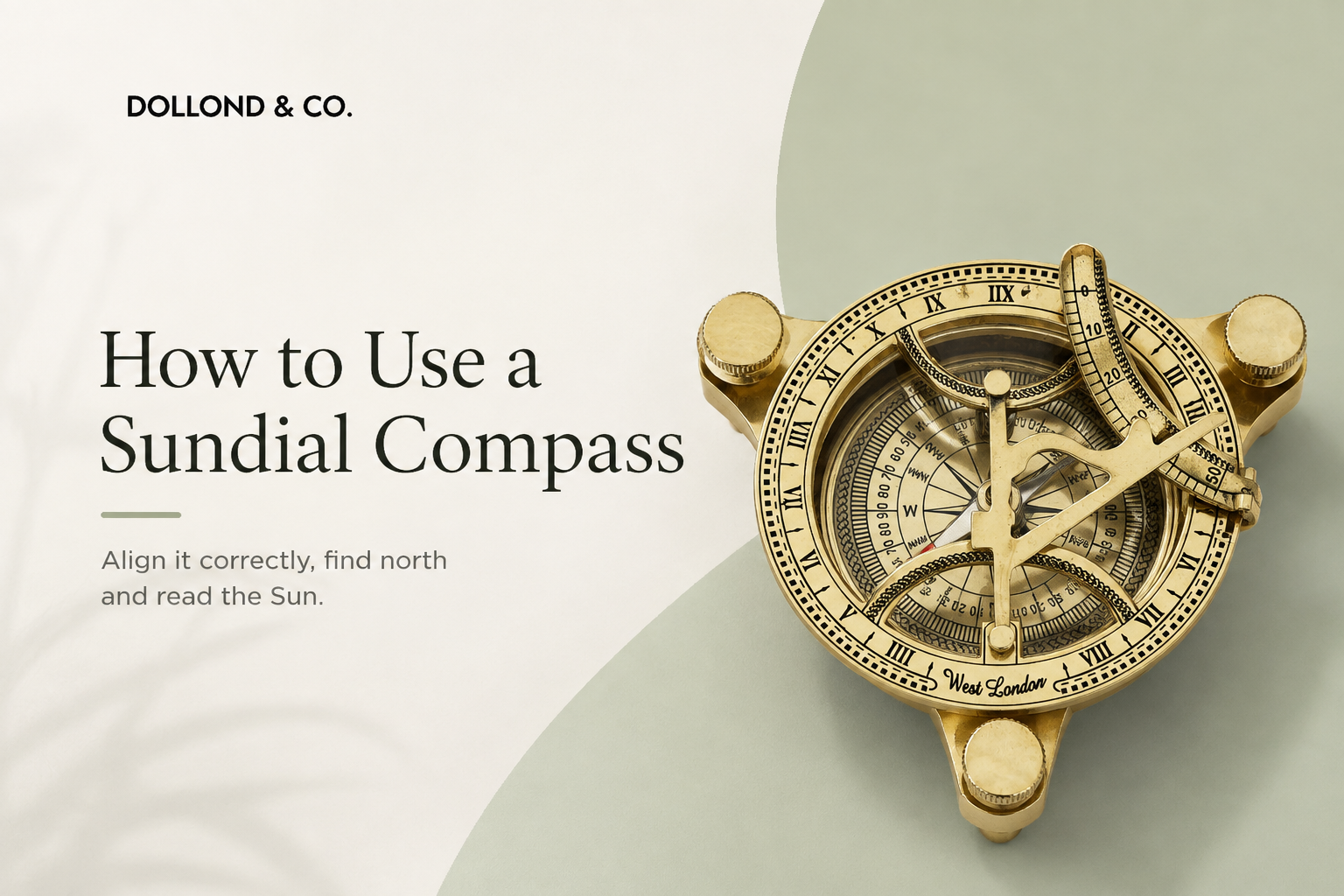
A sundial compass combines a sundial and a magnetic compass within the same portable instrument.
The compass helps the user orient the instrument in the correct direction. Once the dial has been positioned and the gnomon raised, sunlight casts a shadow across the marked time scale.
Depending on the design, a portable sundial compass may include:
-
A magnetic compass
-
A folding or hinged gnomon
-
An hour scale
-
A latitude scale
-
Direction markings
-
A levelling feature
-
A protective lid or case
-
Space for personal engraving
Some historic instruments were highly complex and allowed their users to adjust for latitude, date and geographical location. Royal Museums Greenwich holds several examples of portable and equinoctial dials that combine compasses, latitude settings, hour rings and equation-of-time information.
Modern gift sundial compasses are generally simpler, but they preserve the same essential relationship between sunlight, direction and local solar time.
A Brief History of Sundials

Humans have used shadows to measure time for thousands of years.
Ancient civilisations in the Middle East and North Africa developed early forms of solar timekeeping. Egyptian obelisks were being used as large shadow clocks by around 3500 BCE, while portable Egyptian shadow clocks appeared around 1500 BCE.
Early sundials divided daylight into sections, although these hours were not always equal in length. In some systems, daytime was divided into 12 parts regardless of the season. That meant a summer “hour” could be considerably longer than a winter one.
The development of equal-length hours and more sophisticated geometry led to increasingly accurate instruments. During the Renaissance, makers created many ingenious sundial designs, some of which also indicated dates, seasons, sunrise, sunset and compass directions.
Portable dials became especially popular between the 16th and 19th centuries. They were used by travellers, astronomers, surveyors and people who needed a way to estimate local time away from a fixed clock.
Although mechanical watches eventually became more practical, the sundial remained an important symbol of science, navigation and the passing of time.
How Does a Sundial Compass Work?

A sundial compass performs two connected tasks.
1. The compass establishes direction
The magnetic needle helps the user identify north and south. This allows the sundial portion to be positioned in the correct orientation.
For approximate use, the north marking can be aligned with the compass needle. For greater accuracy, it is important to remember that a magnetic compass points towards magnetic north, while a sundial should ideally be aligned with true geographic north.
The difference between these two directions is called magnetic declination, and it varies according to location.
2. The gnomon casts a shadow
When exposed to direct sunlight, the raised gnomon creates a shadow on the dial.
As the Sun appears to move across the sky, the shadow changes position. The marked hour line nearest the shadow provides an estimate of local solar time.
The gnomon must be correctly angled for the user’s latitude. On a traditional horizontal dial, the angle between the shadow-casting edge and the horizontal surface should correspond to the latitude of the location.
This is why adjustable latitude settings are found on many historic portable sundials.
How to Use a Portable Sundial Compass
Exact instructions can vary by model, but the following method explains the general process.
Step 1: Choose a sunny location
Place the instrument somewhere with direct, uninterrupted sunlight.
Avoid areas close to large metal objects, magnets, electrical equipment or steel furniture, as these can influence the compass needle.
Step 2: Place the instrument on a level surface
A level position helps the compass needle move freely and improves the consistency of the shadow.
If the sundial has adjustable feet or a bubble level, use them before taking a reading.
Step 3: Set the latitude if required
Some sundial compasses include an adjustable latitude scale.
Set the instrument to the approximate latitude of your location. London, for example, lies at roughly 51.5 degrees north.
If your model has a fixed dial rather than an adjustable latitude setting, follow the specific instructions supplied with it and treat the reading as an approximate demonstration of solar time.
Step 4: Raise the gnomon
Open or raise the shadow-casting part of the sundial.
Ensure that it is fully extended and positioned as intended by the design.
Step 5: Align the sundial with north
Allow the magnetic needle to settle.
Rotate the complete instrument until the north end of the needle corresponds with the north marking on the compass. For greater accuracy, apply the appropriate magnetic-declination correction for your location so the dial is aligned with true north rather than magnetic north.
Step 6: Read the shadow
Look at where the gnomon’s shadow crosses the hour scale.
That position gives an estimate of local apparent solar time.
Step 7: Apply any time corrections
A sundial does not necessarily show the same time as a watch or phone.
To compare the reading with modern clock time, you may need to consider:
-
The equation of time
-
Your longitude
-
Your time zone
-
British Summer Time or other daylight-saving adjustments
-
The accuracy of the sundial’s alignment
-
The design and calibration of the individual instrument
For everyday demonstration and enjoyment, an approximate reading is often sufficient. For scientific accuracy, these corrections become much more important.
Why Does Sundial Time Differ from Clock Time?

A sundial measures apparent solar time, while modern clocks generally display mean time.
The Sun does not appear to move across the sky at an absolutely uniform rate throughout the year. This is caused by the Earth’s elliptical orbit and the tilt of its axis.
The resulting variation is known as the equation of time. Depending on the date, a sundial can be around a quarter of an hour ahead of or behind mean clock time.
Longitude also matters.
Greenwich Mean Time is based on the Greenwich meridian. Locations east or west of that meridian experience solar noon at a slightly different clock time. Royal Museums Greenwich gives the example of Bristol, where the Sun crosses the local meridian approximately ten minutes later than it does at Greenwich.
During British Summer Time, a further hour must normally be added when comparing the sundial with the clock.
These differences are not faults in the sundial. They demonstrate that modern civil time and local solar time are not exactly the same system.
Is a Sundial Compass Accurate?
A properly designed and correctly positioned sundial can provide a useful indication of local solar time.
Its accuracy depends on several factors:
-
Correct orientation towards true north
-
Correct latitude setting
-
A level position
-
Clear sunlight
-
Accurate hour markings
-
The shape and angle of the gnomon
-
Longitude correction
-
The equation of time
-
Daylight-saving adjustments
A portable sundial compass is best appreciated as a traditional working instrument, educational object and historical keepsake rather than a replacement for a precision watch, professional survey instrument or safety-critical navigation equipment.
Its charm lies in seeing time indicated by sunlight in much the same way people experienced it centuries ago.
The Difference Between a Sundial and a Sundial Compass
A fixed garden sundial is normally designed for one location and latitude. Once properly installed, it remains aligned with the local meridian.
A portable sundial compass is designed to be moved. The built-in compass helps the user reorient it whenever it is placed in a new position.
A portable model may therefore be more suitable for:
-
Travel
-
Educational demonstrations
-
Desk display
-
Historical collections
-
Nautical décor
-
Personalised gifts
-
Graduation or retirement presents
-
Wedding and anniversary keepsakes
A larger garden sundial can become an architectural feature, while a compact sundial compass offers a more personal and portable connection to traditional timekeeping.
Why a Sundial Compass Makes a Meaningful Gift
A sundial compass combines two powerful ideas:
The compass represents direction.
It can symbolise finding your path, following your purpose and remembering the way home.
The sundial represents time.
It can symbolise important moments, shared years and making the most of the time ahead.
Together, these meanings make the instrument especially suitable for life’s milestones.
Graduation
A sundial compass can represent the beginning of a new path.
Suggested engraving:
Go confidently in the direction of your dreams.
Retirement
It can mark the moment when someone finally has more time to choose their own adventures.
Suggested engraving:
The next chapter begins now.
Wedding or anniversary
Time and direction can represent a couple’s shared journey.
Suggested engraving:
Through every season, wherever we go, we go together.
Birthday
A personalised sundial compass can celebrate the adventures still ahead.
Suggested engraving:
Another year. Another journey.
Travel
It makes a thoughtful gift for someone beginning a journey, moving abroad or exploring somewhere new.
Suggested engraving:
May every road lead to something wonderful.
Father’s Day
A compass can recognise the guidance a father has provided.
Suggested engraving:
Thank you for always showing me the way.
Choosing the Right Sundial Compass
The best design depends on how the gift will be used and displayed.
Size
A smaller sundial compass is easy to hold and display, while a larger design creates greater visual impact and may provide more room for personalisation.
The Dollond & Co. collection currently includes compact 2-inch designs as well as 3-inch and 4-inch models.
Finish
Polished brass has a bright, traditional nautical appearance.
Bronze-style finishes create a warmer, aged character.
Gunmetal finishes offer a darker and more contemporary interpretation of the historic instrument.
The best finish is the one that suits the recipient’s taste and the intended setting.
Engraving space
Before choosing a long message, consider the available surface area.
Short quotations work particularly well on the instrument itself. If the design includes a wooden presentation box, the box may provide additional space for a longer dedication.
Presentation
A wooden box adds protection and makes the piece feel ready to give as a formal gift.
It also complements the traditional materials and historical character of a brass sundial compass.
Frequently Asked Questions
Does a sundial compass really work?
A functional sundial compass can indicate direction and estimate local solar time when it is correctly positioned in direct sunlight. The quality of the reading depends on alignment, latitude, design and the corrections needed to convert solar time into modern clock time.
Can a sundial compass work indoors?
The compass may function indoors if it is away from magnetic interference, but the sundial requires direct sunlight to cast a useful shadow. Ordinary indoor lighting will not normally provide the same result.
Does a sundial show the same time as a clock?
Not always. A sundial shows local apparent solar time. Modern clocks show standard mean time, so corrections may be required for the equation of time, longitude, time zone and daylight saving.
Why does the gnomon need to be angled?
The shadow-casting edge should be parallel to the Earth’s rotational axis. On a horizontal sundial, its angle is therefore related to the latitude where the dial is being used.
Does the sundial need to face north?
In the Northern Hemisphere, the gnomon is generally aligned towards true north. A magnetic compass can help with positioning, but a magnetic-declination correction may be required for greater accuracy.
Can a sundial compass be personalised?
Dollond & Co. offers a collection of personalised sundial compasses in multiple sizes and finishes. Available designs currently include brass, bronze and gunmetal options.
Is a sundial compass suitable for navigation?
It can demonstrate direction and traditional navigation principles, but it should not replace a modern, calibrated instrument for professional or safety-critical navigation.
What should I engrave on a sundial compass?
Popular themes include time, direction, adventure and home. Messages such as “You are my true north,” “Make every moment count,” “Your next adventure begins here” and “Always find your way home” complement the symbolism of the instrument.
Discover Personalised Sundial Compasses from Dollond & Co.
A sundial compass is more than an ornament.
It is a working link to the history of navigation and timekeeping, a demonstration of the movement of the Sun and Earth, and a symbolic gift representing both the journey ahead and the time we share.
Whether you are choosing a graduation keepsake, retirement gift, anniversary present or a distinctive piece for a nautical collection, personalisation allows the instrument to tell an individual story.
Explore the Dollond & Co. sundial collection to discover personalised brass, bronze and gunmetal designs in a range of sizes.